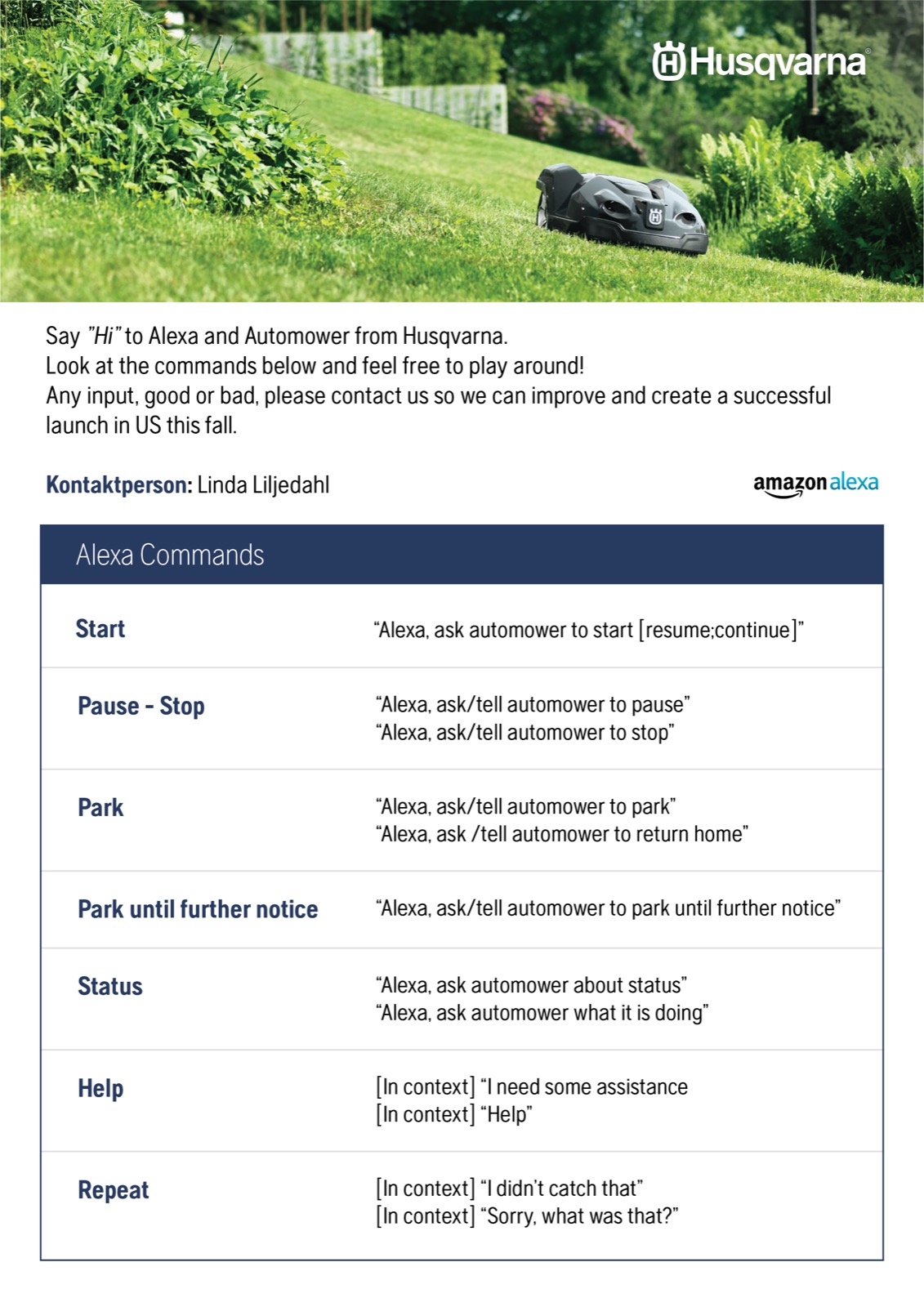
You can't click-test a conversation. Before building the Husqvarna Automower skill for Alexa and Google Assistant, we needed to know how people actually talk to a mower in a kitchen — and no wireframe, no dialog flowchart, answers that. So we staged it.
The workshop
Roleplay sessions with staged household scenarios — scripts like "Hiring a Private Assistant," a birthday morning, even a thief-in-the-house scenario — with one person playing the assistant and others playing the family. The goal, as the workshop brief put it: validate the dialog flow, capture the user's behaviour, and generate insights for upcoming features. Low tech, high fidelity — because the fidelity that matters in voice is conversational, not visual.
What the theatre caught
- Repetition kills trust. People got visibly disappointed at repeated phrases and double confirmations — which is why every confirmation shipped with eight response variations.
- Generic answers feel like failure even when technically correct; context beats correctness.
- People name mowers by garden — the summer house, the front yard — which reshaped the entire multi-mower naming and disambiguation model.
- Asking users about their setup eases the conversation — the skill could earn context instead of demanding it.
The principle
Prototype in the medium the user experiences. For GUIs that's pixels; for voice it's two humans talking; for AI products it's live model behavior, not canned demos. The Automower skill went through Amazon's certification across six locales — but it survived living rooms first, because we rehearsed the play before we built the theater.