
Voice control for robotic mowing — Alexa & Google, 6 locales
The brief
“Alexa, ask my mower to park” — voice control for robotic mowing, designed as a personality rather than a command list. Shipped on Alexa and Google Assistant across six locales.
- Client
- Husqvarna
- Timeline
- 2018 — 2020
- Role
- Conversation Designer
VUI specification & validation - Platforms
- Amazon Alexa
Google Assistant
6 locales
The problem
A robot in the garden, a voice in the kitchen
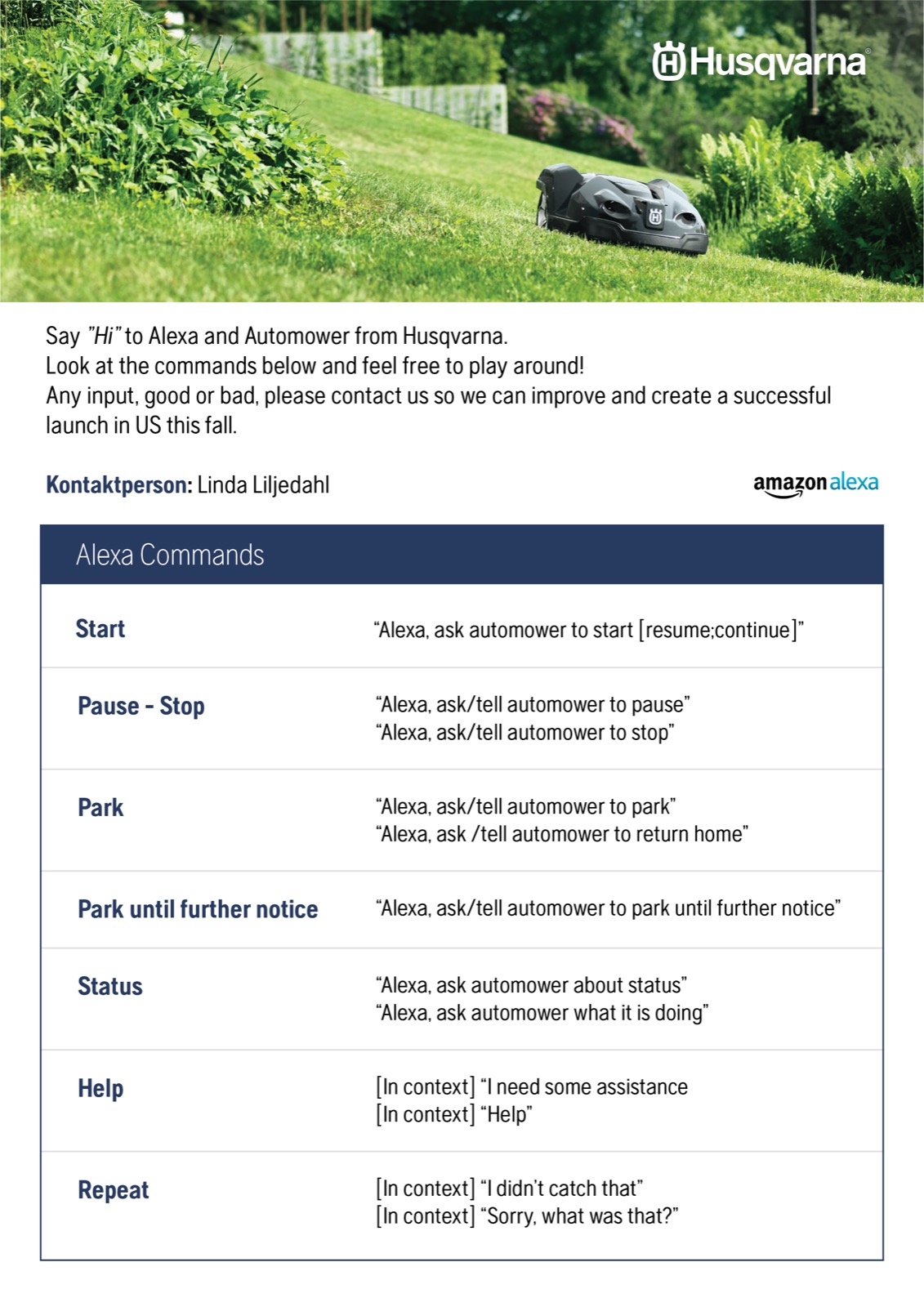
Automower owners wanted hands-free control — start, stop, pause, park, status — with account linking between their assistant and Automower Connect through Husqvarna's open API. But a mower that answers like a machine damages a brand built on effortlessness. Voice interfaces live inside people's daily routines, so the conversation itself carries the brand.
“Voice user interface has the power to affect the users in their daily routine — designing a better user experience is essential to promote brand voice.”
My role
Conversation design, specification to certification
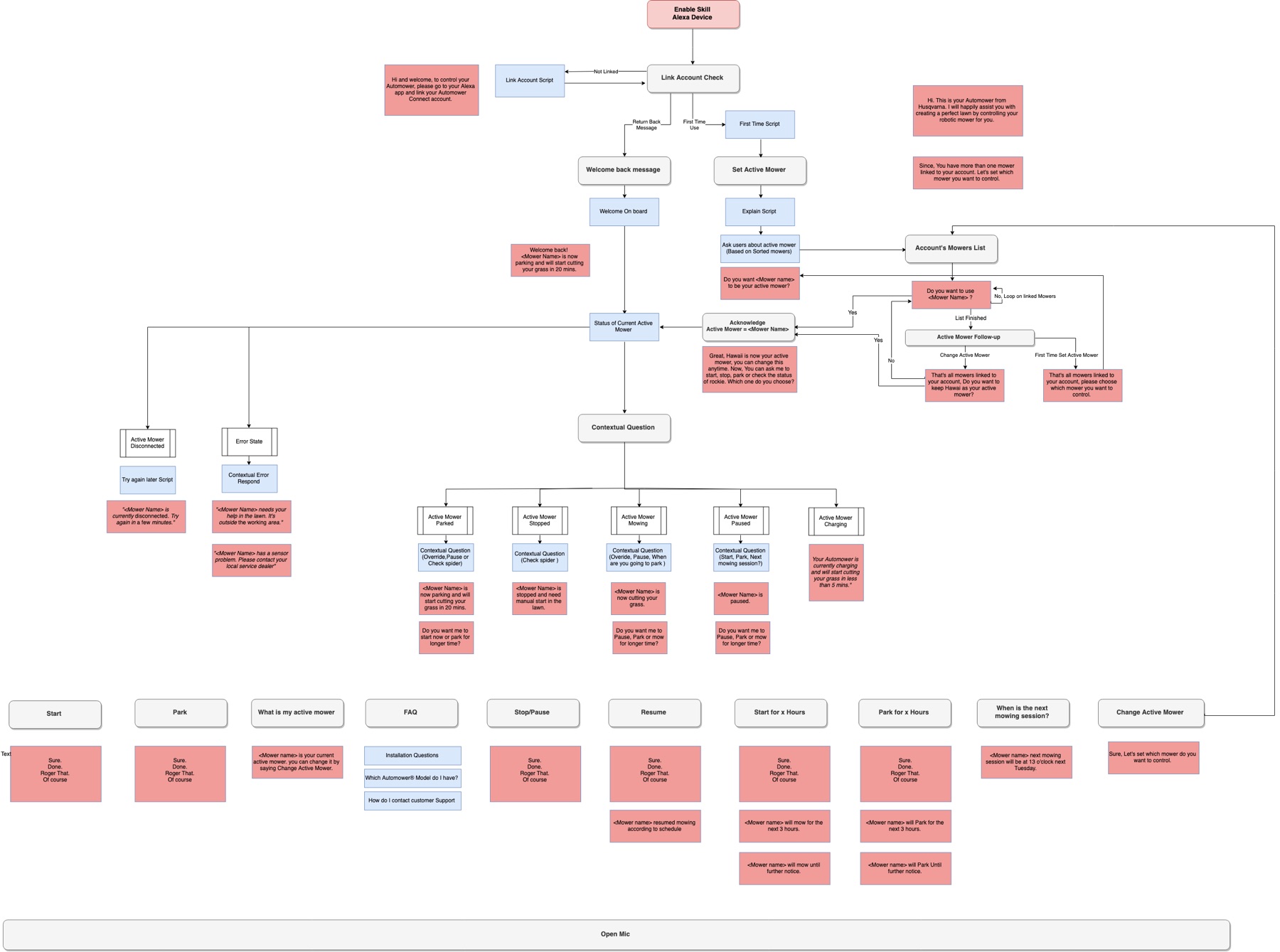
- Full VUI dialog specification — intents, utterances, flows, recovery
- Roleplay workshop design and facilitation with staged household scenarios
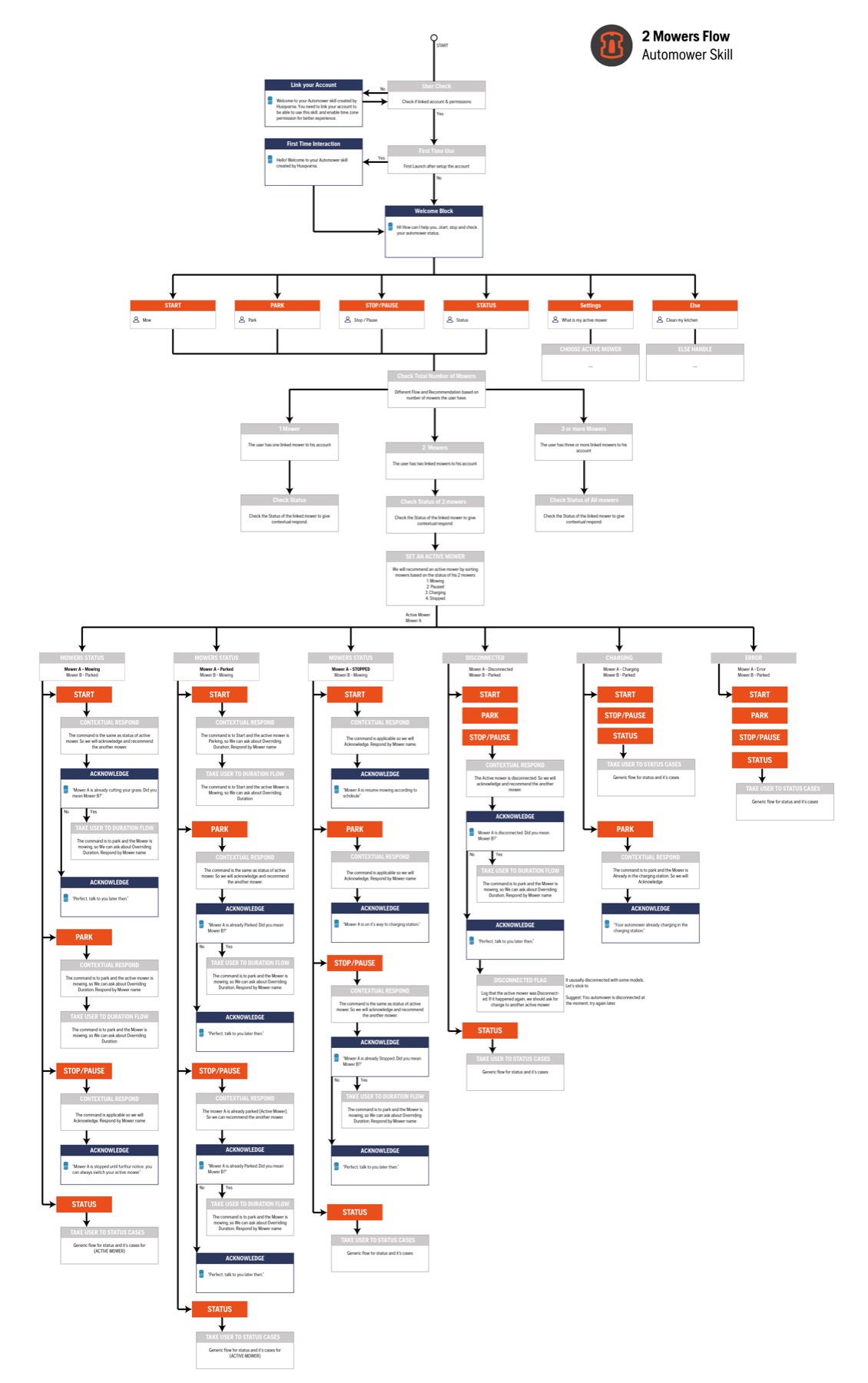
- Dialog flows for single- and multi-mower households
- Iteration through Amazon's multi-locale certification
Decisions & trade-offs
Three calls that shaped the conversation
Two launch models, not one
Open-ended dialog for exploration and direct one-shot commands for routine — because a returning owner saying "park the mower" shouldn't sit through a conversation designed for a first-timer. Separate welcomes for each.
Trade-off — double the flows, half the friction
Eight ways to say “OK”
Every confirmation carries eight response variations — Ok, Done, Roger that, Got it… — because workshops showed repetition is the fastest way for a voice to feel robotic and disappoint.
Trade-off — heavier spec, a voice that stays alive
Name mowers the way owners do
Multi-mower households naturally name machines by garden — the summer house, the front yard. The naming, grouping and contextual-response model followed the users' mental model instead of device IDs.
Trade-off — harder disambiguation logic, natural conversations
Outcome
Shipped on Alexa and Google Assistant, in six markets
The skill released on both platforms, localized across French, US, UK, Australian, Indian and Canadian English — iterated through Amazon's certification, which stress-tested account linking, utterance coverage and slot modelling. Validated in roleplay before a line was built; the Alexa skill is still live today.
What I learned
In voice, personality is the interface
There are no buttons to polish — only words, timing and recovery. Designing for living rooms taught me to test conversations as theatre before building them as software: the roleplay workshops caught what no flowchart could, and that practice followed me into every conversational and AI interface since.