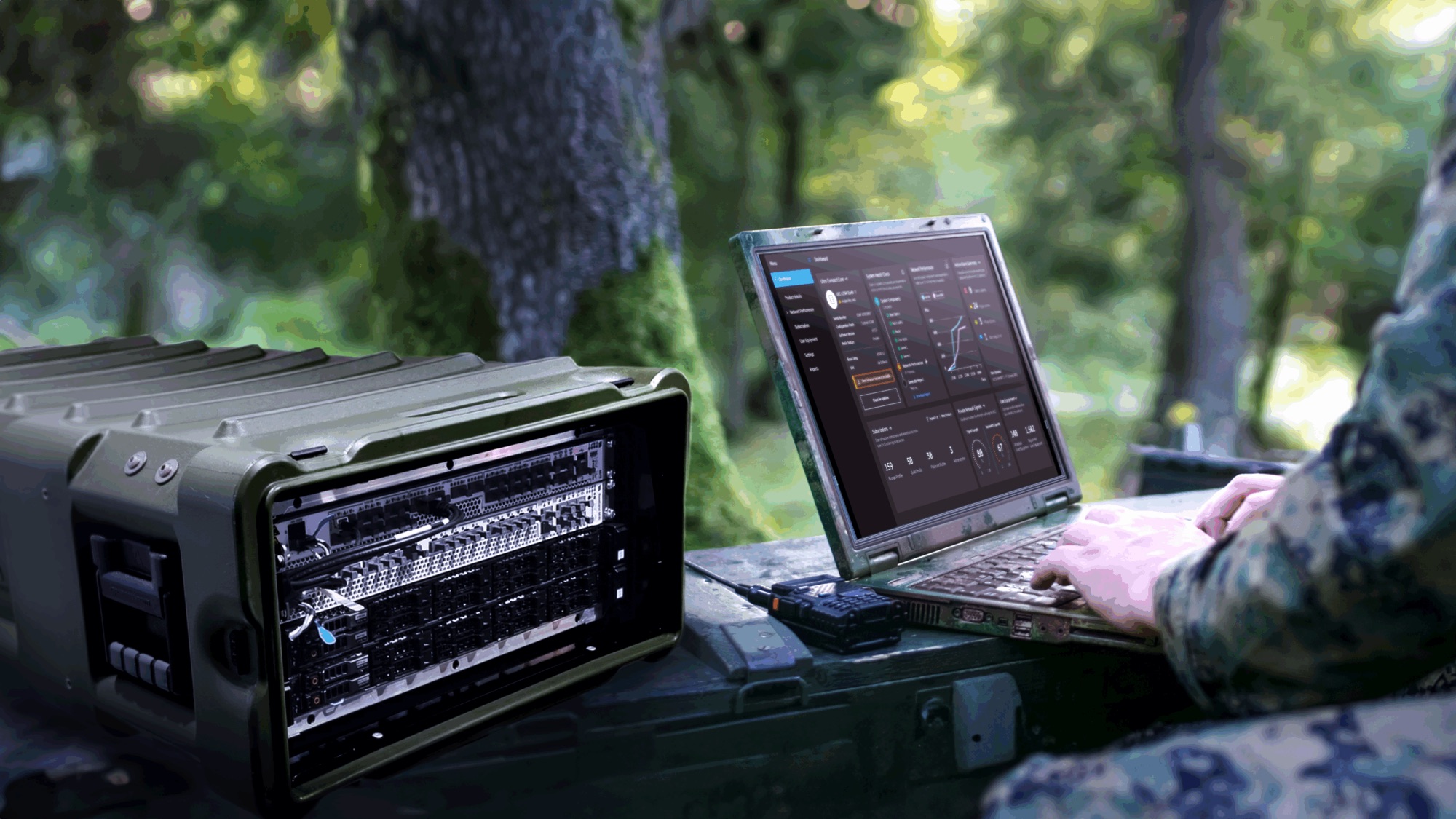
A 5G core for critical missions, radically downsized
The brief
Make a mission-critical 5G core deployable by people who are not telecom experts — field technicians installing networks in tough, time-sensitive environments where there is no room for mistakes. End-to-end UX for Ericsson's defense-grade Local O&M module.
- Client
- Ericsson AB — Critical Mission solutions
- Timeline
- 2023
- Role
- UX/UI Designer, 1.0 FTE
End-to-end UX study - Capabilities
- User research & interviews
Personas & user journeys
UX & UI design
Concept evaluation
The problem
Expert infrastructure, non-expert hands
Ericsson's Ultra Compact Core brings 5G to the field — transportable in a case, pre-configured, operational within minutes. But the person deploying it is a field technician with strong technical proficiency and no telecom background, working under pressure where a mistake can cost a mission. The design challenge: bring the deployment threshold down to their reality — install, verify, monitor, troubleshoot, on location.
“I must deploy critical communication devices out in the field, where it is tough environment, stressful and time sensitive. In our job, there is no room for mistakes.”
My role
The full UX study, end to end
I ran the study solo at 1.0 FTE — from scoping with product owners to evaluated concept.
- Research plan & qualitative interviews with field and partner-telecom personnel
- Persona & end-to-end user journey for the non-telecom field technician
- Insight synthesis into user stories, wireframes and hi-fi UI
- Concept evaluation with military users under realistic conditions
Decisions & trade-offs
Three calls that shaped the module
Start from an admitted assumption
The first persona was labelled openly as a placeholder — "an assumption statement until meeting real users" — then rebuilt from interviews. Honesty about what we didn't know kept the research honest too.
Trade-off — slower certainty, no false confidence
Design for the health check, not the dashboard
Research showed success on-site means one thing: verify the network is good enough, fast — KPIs for coverage and installation, step-by-step guidance, alarms that mean something to a non-expert.
Trade-off — less monitoring surface, more deployment confidence
Evaluate with the real audience before sign-off
A second research round put the concept in front of military personnel to test whether the Local O&M was intuitive under field conditions — before development committed.
Trade-off — an extra round, a validated direction
Recognition & traction
Deployed where it matters
Ericsson markets Ultra Compact Core as "operational within minutes", transportable in a case or vehicle — and Orange deployed it for Madrid's public-safety mission-critical 5G network.
Protected deep dive
The full story is behind a password
Client-confidential work — the research, iterations and outcomes are shared with reviewers on request.
Chapter 01
Framing
A hypothesis about non-experts deploying expert infrastructure.
Chapter 02
Research
Interviews and journeys from the field.
Chapter 03
Reflection
What designing for the field taught the design.